Friday, January 29, 2010
does caffeine affect performance?
The International Society of Sports Nutrition just released a position stand on the subject. You can access it right here.


Tuesday, January 26, 2010
Youth Sports Safety Summit
There have been 115 sport-related youth deaths since January 2008 in America. To address this growing problem, the NATA recently organized the Alliance to Address the Youth Sports Safety Crisis in America and held a summit on Jan. 12. The purpose of the Alliance, comprised of 30 healthcare and sports organizations, is to raise awareness, advance legislation, and improve medical care for young athletes across the country. A major goal in this endeavor is to help put an end to what has been labeled a crisis.
To read a summary of the event, click here.
To read a summary of the event, click here.
Monday, January 18, 2010
thoughts on steroids and the "confession"
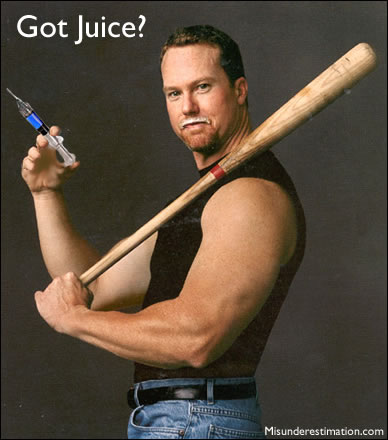
I have had a lot of conversations over the last week regarding Mark McGwire's "revelation" concerning his drug use. Because of my connection to bodybuilding, many people assumed in the past and still ask me today about the topic. The general public is still largely misinformed about steroids and other performance enhancing drugs; how do they work, why do they work, what are the side effects, etc.
I have been around steroids since 1990. I have never taken them. I have seen guys (and girls) inject them, swallow them, sell them, and distribute them. It is much more prevalent than you would realize. Many of my friends have taken them. I am not an advocate of steroid use, but I do advocate making intelligent decisions. If you are going to put something in your body that may harm you, at least inform yourself of what the potential side effects are. Please don't read into this that I condone steroids use; people will use them whether you tell them to or not. I have an obligation to help them make a decision if they ask me for help. Here are a few other thoughts about steroids and other drugs:
* They work...but not for everyone. Judging the effectiveness of the results by the people who I know took them, they will work for 80% of the people who try them. By using the word "work" I am implying that they make you stronger, bigger and more aggressive.
* They work much better for people who have good genetics to begin with. Steroids don't change your DNA, per se; they won't make your collarbones wider or your hips smaller. They will target certain receptor sites located all over the body and flood them with signals to grow at accelerated rates.
* They will not replace poor eating habits, poor exercise habits or poor work ethic.
* They are psychologically, not necessarily physiologically, addicting.
* They won't necessarily make you into an a-hole; but they will make you a bigger a-hole if you were one already!
* They have legitimate medical purposes and uses, especially for muscle-wasting diseases.
* The biggest market for these drugs in the future may not be athletes, but (older) men whose natural testosterone may be too low (similar to women and Hormone Replacement Therapy after menopause).
* Most, but not all, elite physique athletes have taken, or currently are taking, performance-enhancing drugs, including steroids, growth hormone, insulin, erythropoietin, methamphetamines, and pain killers, among others. The sports that have the highest rate of use are bodybuilding, powerlifting, weight lifting, track and field and football. While cycling also has a high rate, they are very specific to the types of drugs they use.
I believe that the next wave of enhancing performance will be gene doping, or changing what genes we turn on or off to achieve a desired result. It is currently being studied and used in animals. Humans will be next, for better or worse. It is our natural desire to want to be the best, blindly turning our minds away from the potential consequences. If a pill or a needle holds that hope, that gold medal, that world record, that trophy, then we will do it.
Tuesday, January 5, 2010
thoughts on strength - part 2
My last post (thoughts on strength - part 1) received a lot of good reviews, so here is part 2.
Before I go into detail on my opinion of strength training for youth, there are a few more highlights to share that will help strengthen my point (pardon the pun). As I mentioned, I started lifting weights when I was 13 or 14, I can't remember exactly. It never stunted my growth, I never broke a growth plate, I never was injured playing sports and I never committed random acts of violence because of my new-found passion. Had to get that out of the way to squash some myths :)
As I entered high school athletics, I realized that, while I was strong and fast, I was smaller than just about everybody else on the field, diamond, court and mat. So, just to compete, I had to attack the weight room with even more fervor and intensity. I remember the first time I could bench press 100 pounds...what a feeling! But, that only made me want to do more. Fast forward to my senior year: I was now a powerlifter in the 125 pound weight class with personal best's of 235 in the bench, 315 in the deadlift and 300 in the squat. Keep in mind I was 125 pounds soaking wet.
I was gaining strength weekly, it seemed. I gradually weaned myself from my love of playing sports to only concentrating on my lifting. In my senior year, I was hospitalized for a month for various ailments, but still managed to lift. I would lie under my bed and do push ups with the bed frame, put two chairs side by side and do dips. I would load up my book bag and squat and deadlift with it. Yes, I was a little nuts. When you find your desire, no one can take that away from you. As I entered college, my powerlifting transferred into bodybuilding. My body finally hit puberty around 18 and I was adding muscle by the week. I entered my first of 17 bodybuilding shows and the rest is history...
When I look back at the tools that were forged via lifting weights, the one constant that never stopped growing was my self-confidence. I was a classic under-achieving student and a pretty good athlete, but was also aware that I never quite fit in with everyone else. High school can break a young kid if he/she let's it. The ironic thing is that while I was using weights for my own selfish gains, I also became more popular. It was purely unintentional, but it happened. Strength and muscle have always had a cartoonish or cult like-quality to those that admire the athletes that partake in it. Weights then had a two-fold purpose: the obvious one of strength gains but also gaining acceptance among my peers. It felt phony but I didn't care.
The reason I bring this up is to show the wide ranging effects that strength training can have on a growing boy or girl. In short, strength training can:
* Improve self-esteem, self-confidence and body image perceptions;
* Decrease injuries by making connective tissue, joint structures and muscles more resilient to potential trauma;
* Improve ALL indices of sport and athletic skill development. This is the biggie. If you want to:
Jump higher....run faster....stop quicker....tackle harder....kick further....swing faster, etc. then strength is the one component that will help every other component of athleticism.
Every sport relies on one major aspect: the production and application of FORCE. From hitting to kicking to swimming to throwing to jumping to running and everything in between, the constant is the application of force to an object, whether it be a ball, a person, water, or the ground. In order for force to improve, strength must improve.
If you think your son or daughter is too young to strength train, think again. They will be exposed to more dangerous conditions while playing sports then through lifting weights. Gymnastics? Strength training! Football? Strength training! Baseball, soccer, jungle gyms, swing sets, recess, phys. ed., running, cutting....all involve the application of force, thus are forms of strength training! The negative perception of strength training stems from junk science from several years ago outlining the dangers of strength training for young kids. This has since been updated to reflect new research. All forms of activity come with risks, but lifting weights, under supervision, has one of the safest track records relative to sports such as soccer, football and gymnastics, among others.
Notice that I am not using weight training in the same context as strength training. They are not necessarily synonymous. The strength training that I advocate for youth consists of medicine balls, bands, ropes, tires, sleds and, of course, bodyweight. There is room for light dumbell and kettlebell work as well. To be blunt, kids are weak (it hurts me to watch kids struggle with their own bodyweight as resistance). I have several theories why that is, but at the end of the day, it doesn't matter how they got that way; the question then becomes, "What are we going to do about it!?"
I hope that you enjoyed this and maybe even learned something. Strength is an unbelievably powerful tool that can transcend the weight room, playground or athletic world. Get strong. Stay strong.
Wednesday, December 30, 2009
thoughts on strength - part 1
For the better part of the last 25 years, I have been involved in some sort of strength training. I started out around 13 years old with metal pipes welded to my basement beams for pull ups, solid steel dumbells that I watched my dad use every morning to build his body into granite, a barbell set that had sand for weight instead of metal and my own bodyweight. They were the tools that I would wage war against every night for 2 or 3 hours. I remember the punching bag that had bloody reminders written all over it from the continuous punishment that it inflicted up on me. I loved every second of it.
While I was getting stronger physically, I was also building confidence, aggression and pain tolerance. There was nothing the world could do to me that the weights hadn't done to me already. I was constructing a suit of armor that nothing could penetrate, and, consequently, did not let anything out at the same time. I was forging my identity.
The weights don't lie to you. They are your friend, and your enemy. They are relentless. If you think you are strong, they will humble you and challenge you to put more weight on the bar. They do not praise you nor do they shame you. They do not share in your victories or cry in your defeats. They are always there for you when nothing else is. They are tested and true - they will never let you down or leave you for another.
Strength itself is very individual - you can make it as little or as big as you want to. For me, lifting weights was the only thing I could identify with, and still can much to this day. With a barbell, I know what I am getting - the cold steel in my hands is as comforting as a mother's loving touch to a crying child. Along with the obvious physical connection, I relied on the weights to give me what I wanted emotionally as well: solace, peace, purpose, making sense of the senseless, drive, pleasure, the list could go on. But most of all, I summoned the weights to give me the one thing that nothing else could give me: Pain.
I never felt more alive when I could hear my tendons and ligaments on the brink of ripping off my bones; when my muscles would beg for mercy as I unleashed set after set, rep after rep. I did not care about anything until I could feel the pain of my body while I was training. Up until that point, I did not know how to feel anything. With the weights in my hand, I could feel everything. Pain was a "gateway" emotion that taught me how to develop other emotions. I became addicted to the pain and nothing could replace it.
I can say without doubt that weights made me who I am today, taught me more than any textbook, and helped me out of the darkest periods of my life. In part 2 I will go over why I believe every kid - even non athletes - should be doing some sort of strength training no matter the goals, age, sport, sex or other labels.
Wednesday, December 23, 2009
Health Care Reform starts with kids....are you listening Obama?!
Statistics rarely lie....Only 8 percent of elementary schools, 6.4 percent of middle/junior high schools and 5.8 percent of high schools require daily PE. That is pathetic and embarrassing; almost criminal. Yet in Obama's Reform Bill, school-based PE is not even addressed. Here is a good article outlining the problem.
Sunday, December 13, 2009
specialization at a young age: more harm than good?
I tend to agree with this article that we are not doing a very good job of developing well-rounded athletes but more burned out, injured and overtrained kids.
Subscribe to:
Posts (Atom)